What Determines the Price of Manufactured Liquor Products?
Walk into any wine shop in India and you’ll notice something strange: two bottles that look almost identical in size, packaging, and alcohol content can be priced ₹200 apart and that gap might double again if you cross a state border with the same bottle in your bag. For someone outside the industry, this looks like random pricing. For anyone running, or planning to enter, a liquor manufacturing business, it’s anything but random. The final price tag on a bottle of whisky, rum, vodka, or country liquor is the sum of several distinct cost layers, each shaped by raw materials, regulation, packaging, and distribution logistics that are unique to how alcohol is produced and sold in this country.
This post breaks down each of those layers so that anyone evaluating a manufacturing or bottling partnership or simply trying to understand why their favourite brand costs what it does has a clearer picture of where the money actually goes.
1. Raw Material Costs: Where Every Bottle Begins
At the core of nearly every Indian-made spirit is Extra Neutral Alcohol (ENA), a highly rectified, near-flavourless alcohol typically distilled to around 96% strength. ENA is produced either from sugarcane molasses or from grains such as maize, wheat, barley, and broken rice. As of the past year, bulk ENA has generally traded in the range of roughly ₹50 to ₹65 per litre, though this fluctuates with sugar harvest output, monsoon performance, and how much molasses gets diverted to ethanol blending programmes instead of the beverage industry.
Grain-based ENA tends to run slightly costlier than molasses-based ENA because grain has competing demand from food markets and the government’s ethanol-blending push, which has been steadily pulling grain stock away from potable alcohol producers. This single input choice — molasses versus grain — already creates a meaningful cost gap between a basic IMFL (Indian Made Foreign Liquor) brand and a premium grain-based whisky.
Beyond the base spirit, manufacturers also factor in:
- Flavouring essences, colourants, and blending concentrates (these vary enormously based on whether a brand is mimicking a Scotch profile or a rum profile)
- Water treatment and de-mineralisation, since water quality directly affects the final taste and shelf stability
- Quality control testing at multiple stages, which is non-negotiable for excise compliance
For any liquor distillery, this raw material slab forms the “floor” of the cost everything else is added on top.
2. State Excise Duty: The Single Biggest Price Driver
If you remember only one fact from this article, make it this one: alcohol for human consumption is kept outside the GST framework entirely, and instead falls under state excise duty and VAT, two levies that states control independently and use as a major source of revenue. In several states, the combined tax burden on a bottle can cross 60% of its retail price, and in some categories it goes even higher.
This is also why pricing isn’t uniform. Rajasthan, for example, has structured its IMFL excise duty in price-based slabs, bottles priced below a certain MRP attract one duty rate, while higher-priced bottles attract a steeper rate. Karnataka recently overhauled its system entirely, moving away from flat per-bulk-litre duty toward a structure based on the actual alcohol content of the beverage, while also giving manufacturers more flexibility to position products within pricing slabs based on demand and brand positioning.
For a company operating a liquor manufacturing business across multiple states, this means the exact same recipe, bottled identically, can carry a completely different price depending purely on which state’s excise department it’s sold under. This is one of the main reasons large manufacturers prefer to operate bottling units in multiple states rather than shipping finished stock across state lines, it simplifies compliance with each state’s duty structure and reduces the permit-heavy process of interstate alcohol movement.
3. Liquor Bottling and Packaging Prices
Packaging is where consumers actually “feel” the price difference, and it’s a far bigger line item than most people assume. A standard 750ml glass bottle, bought in bulk, can cost anywhere from roughly ₹10 to ₹25 for basic clear glass but that’s before caps, labels, and finishing.
Once you add the rest of the packaging stack, the numbers shift considerably:
- Caps and closures – tamper-evident ROPP (roll-on pilfer-proof) caps are mandatory for most spirits and add to per-unit cost, especially with security features
- Labels and printing – foil stamping, embossing, and multi-colour printing for premium brands can multiply label costs several times over basic paper labels
- Excise security holograms and barcoding – many states require unique tracking labels per bottle for revenue tracking, which is a direct compliance cost
- Secondary packaging – corrugated cartons, dividers, and shrink-wrapping for case-level shipping
For a mass-market IMFL bottle, total liquor bottling and packaging prices (bottle + cap + label + secondary packaging) often land somewhere in the ₹20–40 range per unit. For premium and super-premium brands using custom-moulded bottles, heavier glass, embossed branding, and luxury closures, this figure can climb well past ₹100–150 per bottle — sometimes becoming one of the largest non-tax costs in the entire pricing structure.
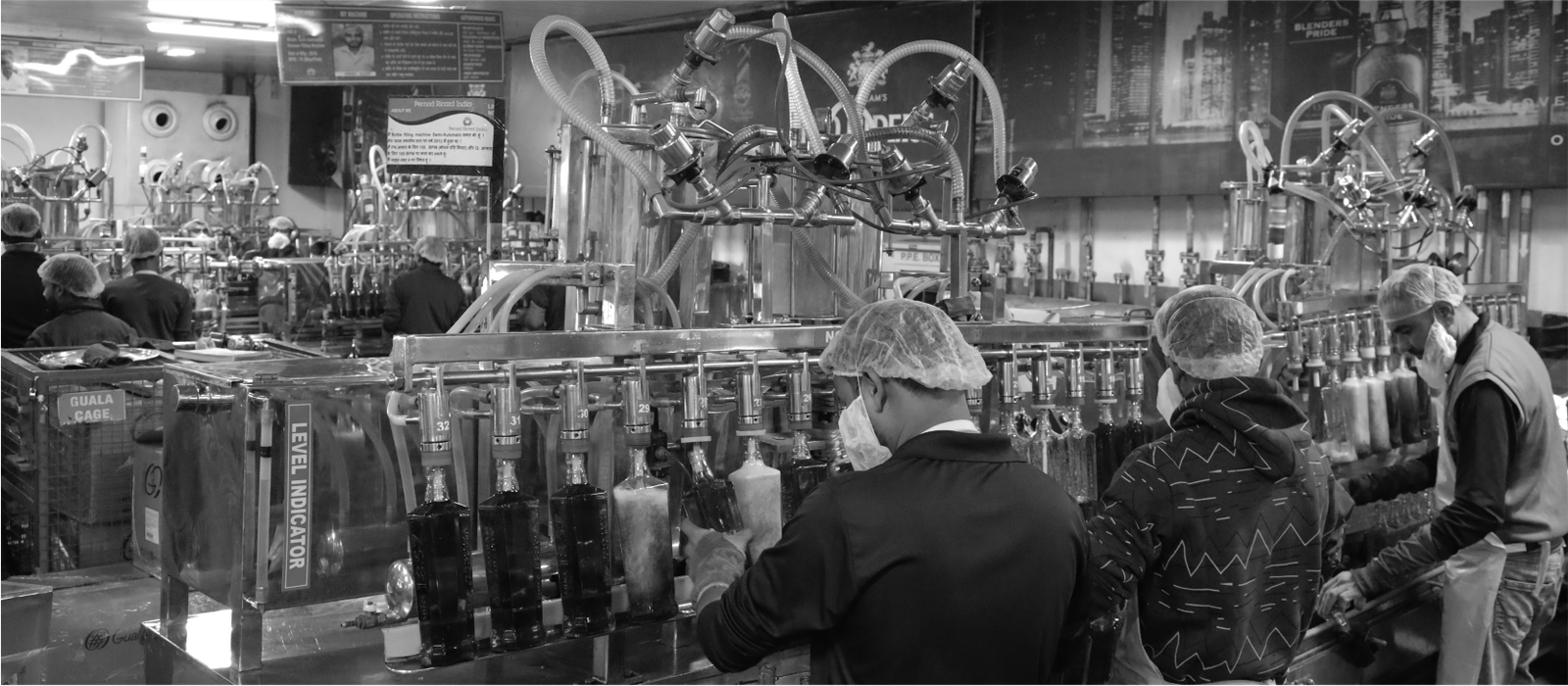
Bottling itself also has a cost dimension that’s separate from the materials. Fully automated bottling lines — which can fill, cap, label, and case thousands of bottles per hour — bring down the per-unit labour cost significantly compared to semi-automated lines, but they require serious capital investment. This is part of why many brand owners choose to partner with established liquor bottling operations rather than building and running their own lines, particularly when entering a new state market.
4. Distillation, Blending, and Maturation
Not all spirits leave the distillery the same way. A large share of Indian whisky, brandy, and rum is produced through a blending process — ENA combined with flavouring agents, caramel colour, and water, then filtered and bottled relatively quickly. This is the most cost-efficient route and explains why a large category of bottles can be priced affordably even after taxes.
Malt-based and aged spirits follow a completely different cost path. Maturation in oak barrels ties up capital for years — the spirit sits in storage, a portion evaporates (commonly referred to as the “angel’s share”), and the barrels themselves, especially imported oak casks, are expensive and have a limited reuse life. Add warehousing costs, insurance on aging stock, and the simple fact that money invested in a barrel today won’t generate revenue for several years, and it becomes clear why aged single malts and premium whiskies carry such a price premium compared to blended counterparts from the same liquor distillery.
5. Licensing, Compliance, and Regulatory Overheads
Before a single bottle is produced, there’s a substantial regulatory cost layer. Setting up a distillery in India covering land, plant and machinery, effluent treatment systems, and licensing can broadly range from around ₹5 crore for a smaller unit to upwards of ₹20 crore for a larger, more automated facility, depending on the spirit categories produced and the state’s specific licensing requirements.
On top of the one-time setup cost, manufacturers pay recurring annual licence fees (which vary widely by state and by category distillery, bottling unit, brewery, etc.), bond warehouse compliance costs, and brand/label registration fees that often need to be renewed state-by-state for every SKU a company sells. None of this is visible to the consumer, but it’s baked into the manufacturing overhead that every bottle has to absorb.
6. Distribution, Logistics, and the Job-Work Model
Because alcohol is regulated as a state subject, moving finished stock between states involves export and import permits, and in several states, sales are routed through state beverage corporations that add their own margins. Glass bottles are heavy and fragile, so transportation, breakage allowances, and insurance form another real cost component particularly for brands trying to maintain a presence across northern, western, and southern markets simultaneously.
This is also where the contract bottling or “job work” model becomes relevant. Rather than every brand owner building distillery and bottling infrastructure in every state, many large spirits companies partner with regional bottling units that already hold the necessary state licences and production capacity. The brand owner supplies the formulation and branding, the bottling partner handles production under a structured job-work agreement (covering job work charges and, in some cases, lease arrangements), and the finished product moves into that bottling partner’s regional liquor distribution network. This model lowers the capital burden for brand owners and allows faster entry into new state markets but the job-work fee itself becomes another component of the final cost stack.
7. Brand Positioning and Marketing Spend
Finally, there’s the cost that’s hardest to quantify but very real: brand building. India’s advertising regulations restrict direct alcohol advertising, so companies spend heavily on surrogate marketing, sponsorships, premium retail placement, and packaging design all of which factor into how a brand is priced relative to its actual production cost. Two bottles with nearly identical liquid inside can be positioned at very different price points purely based on how much has been invested in the brand around that liquid.
Bringing It All Together
For anyone evaluating a liquor manufacturing business whether as an investor, a new brand owner, or an existing player looking to expand into new states, the final MRP on a bottle is really a stack of independent decisions: which raw material base to use, which state(s) to manufacture and sell in, how much to invest in liquor bottling and packaging prices versus keeping things basic, whether to blend or mature the spirit, and whether to build in-house production or work with an established bottling and distribution partner who already understands the regulatory landscape in a given state.
Getting this stack right and choosing the right manufacturing and bottling partners along the way often matters more to long-term profitability than the formulation itself.
FAQs
1. Why does the price of the same liquor brand vary from one state to another in India?
Alcohol pricing in India is heavily influenced by state excise duties, VAT, licensing fees, and local regulations. Since each state has its own tax structure, the same bottle can have different retail prices across different regions.
2. How do liquor bottling and packaging costs affect the final price of a bottle?
Packaging is a significant cost component in the alcohol industry. Expenses related to glass bottles, caps, labels, security holograms, and secondary packaging all contribute to the final retail price, especially for premium brands.
3. What is the role of contract bottling in the liquor industry?
Contract bottling, often called the job-work model, allows brands to partner with licensed regional bottling facilities instead of building their own infrastructure. This helps reduce capital investment and enables quicker expansion into new markets.
4. Why are aged whiskies and premium spirits more expensive than regular blended products?
Premium spirits often undergo long maturation periods in oak barrels, which increases production costs through storage, evaporation losses, barrel expenses, and capital tied up for several years before the product reaches the market.
5. What factors should businesses consider before entering the liquor manufacturing industry?
Businesses should evaluate raw material sourcing, state regulations, taxation, manufacturing capacity, distribution networks, packaging requirements, and compliance costs. Partnering with an experienced manufacturer such as Rajasthan Liquors Limited can also help navigate operational and regulatory complexities more effectively.
Also Check: Bombay Sapphire Price in India | Chandon Brut Price in India